Split login
A reusable square-edged sign-in screen with BluKavantUI colors and a component-built workspace preview.
Screen preview
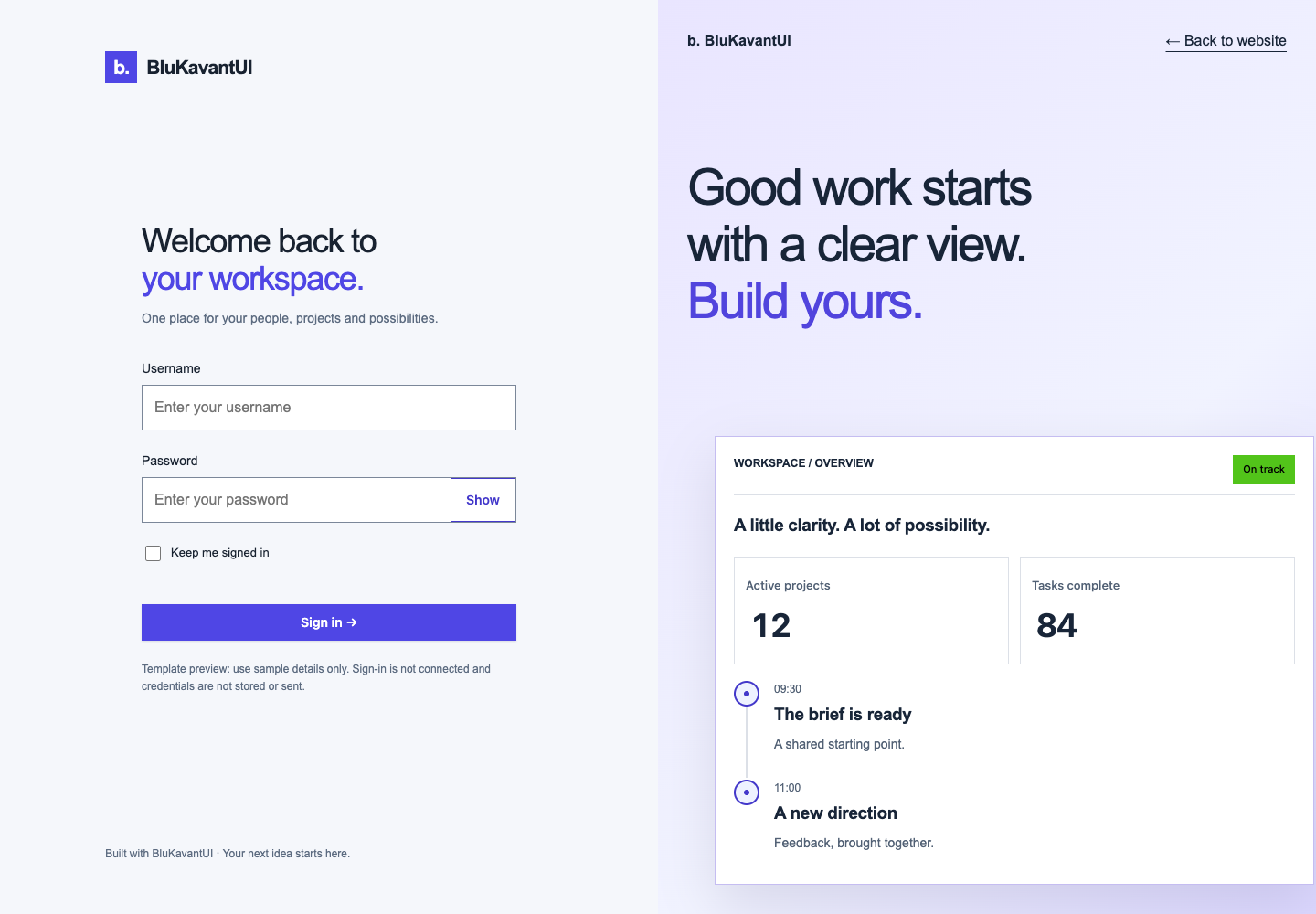
The image below shows the TypeScript screen. Open the web preview to try its controls; it runs the same source included in the starter.
What is custom?
A reusable split sign-in screen with square edges, BluKavantUI indigo/slate colors, labelled form controls, a web password-visibility control, and a live component preview. It is available independently of the demo’s login.
Additional CSS: website-templates.css owns template layout, typography, branding, spacing, responsive rules and finite entrance effects. It respects reduced motion. Component behavior remains in the library.
Web / TypeScript setup
Components used
Button · Card · Badge · Statistic · Timeline
Files to copy
login.ts · website-shared.ts · website-templates.css
- Install
@blukavantui/communityusing the downloadable starter. Copy these files together into your templates directory. - Load
@blukavantui/community/theme.cssonce. Keep the component CSS imports and the localwebsite-templates.cssimport; use a bundler that supports CSS. - Call
mount(host, env), then calldestroy()when removing the screen. Each instance owns and disposes its components.
import '@blukavantui/community/theme.css'
import {mount} from './templates/login'
const screen = mount(document.getElementById('app')!, {
  assetBase: '/assets/templates/',
  galleryUrl: '/templates',
})
// On route exit: screen.destroy()
Data and actions
Provide env.onSignIn({username, password, remember}) to call your server authentication endpoint. Supply forgotPasswordUrl only when a working recovery route exists, plus backUrl for the return link. The preview never sends or stores credentials. On success, your application controls navigation.
Images and appearance
The product preview is rendered with components, not a screenshot. Marketing screens explicitly use the light palette for their branded compositions. Split Login follows the application theme for its form and uses the light palette for its workspace illustration. The local composition styles preserve the template’s visual identity; test your replacement content and colors for contrast, keyboard operation and mobile reflow.
OutSystems Community setup
Copy TemplateLogin from BluKavantUi_Community_Demo, together with its private SplitLoginLayout layout and required assets. Producers: BluKavantUi_Community_Core, BluKavantUi_Community_Layout, BluKavantUi_Community_Data.
Components: Button · Card · Badge · Statistic · Timeline.
- Select the referenced Blocks, public structures and static entities in Manage Dependencies. Use the original producer-owned types.
- Set
BluUICommunityThemefromBluKavantUi_Community_Coreas your consumer’s Base Theme. - Copy
SplitLoginLayoutwith its Style Sheet and placeholders. Preserve the screen’s classes, locals, lifecycle and event handlers. Each library Block supplies its own runtime and CSS. - Replace sample data and preview actions with validated Server Actions. Apply your own access roles; do not inherit demo permissions blindly.
Copy TemplateLogin and SplitLoginLayout as a reusable starting point. Replace the preview SignIn action with your server authentication action. Preserve labelled fields, username/current-password autocomplete, password masking and error feedback. Authentication, remember-me, exception handling and return navigation remain owned by your application.
The native shared layout includes website-templates.css plus scoped adjustments for native wrappers and the existing login form. Copy its full Style Sheet with the layout.
Community on Web and OutSystems
Every component used by this template is Community. The Community Web starter includes this screen and its shared files, using @blukavantui/community.
The native TemplateLogin screen is published in BluKavantUi_Community_Demo. Copy its private SplitLoginLayout layout and preserve producer-owned types, scripts and event mappings. Your application supplies access roles, authentication and persistence.
All nine Community and five Pro native templates are published in the development environment. Official Forge distribution remains pending.